Thursday, April 14, 2011

The Alan Sillitoe statue fund


My appearance in today's edition of the Nottingham Evening Post; I'm the one in the the top right hand corner. The one with the facial hair. I'm working with the Alan Sillitoe Statue Fund Committee on various projects to publicize and raise money for a commemorative statue of Alan Sillitoe in his home town of Nottingham.

We're hoping to have a website up and running by early next month; I'll post a link when it goes live. In the meantime, The Sillitoe Project continues here on The Agitation of the Mind next week with a review of 'The Loneliness of the Long-Distance Runner'.

Tuesday, April 12, 2011

Seizure (guest review by Aaron)

Thanks once again to my buddy Aaron for contributing a guest review.

Edmund (Jonathan Frid) is an accomplished horror author who's referred to as "the modern-day Edgar Allan Poe". He has recurring nightmares about being terrorized by three of his own characters, but the nightmares eventually become a reality for Edmund and his houseguests one weekend when they actually show up at his home and force everyone to partake in a series of sadistic games. There's Spider, the Dwarf (Herve Villechaize), Jackal, the Executioner (played by the naked black cop with the cowboy hat from CRUISING), and their leader, the Queen (Martine Beswick). Jackal is a mute, whereas Spider constantly runs his mouth and talks a big game, but the Queen calls the shots.


If anyone knows how to make a grand entrance, it's Herve Villechaize's character in this film. Edmund and his houseguests are understandably startled by a brick that crashes through a window, which, unbeknownst to them at the time, signifies the beginning of the end. Following the breaking of the window, Spider calmly crawls through it and plants himself in the center of the living room with his hair pulled back into a tight ponytail to reveal his beady eyes. In his thick French accent, Herve recites the following lines:

"Now, we will play a lillah game. The game is fun for da young, but penful for da old. It will match each of you against the uzzer in a razor un'da rouse [ed. 'race around the house']. Supair-vised by my poor mute friend Jackal, five time you will make da circle. Until the [inaudible] of you cross the finishing line. Last. He... or she... will be executed."


Not much is known about Spider, other than the fact that he obviously slays animals much larger than he, such as bears or tigers. This is evidenced by his trophy necklace made of animal teeth. He's killed so many animals that he ran out of room around his neck and made a belt from the leftover fangs he's collected. And, the reason why I'm putting a lot of focus on Spider instead of talking about the film's FAUST influences and whatnot is because he's one of the highlights of this surprisingly "OK" film. For me, there's nothing scarier in this world than sharks and a hairy Herve Villechaize running at you with a knife in hand, and why more horror movies didn't capitalize on this while the troubled French actor was still alive, I have no idea. I'd rather be visited in the middle of the night by a clown covered in spiders than Herve Villechaize... or a shark.

It should be noted that Spider, the Dwarf makes small appearances (get it?) earlier in the film before making his presence known to Edmund and the rest of the houseguests. One of the older female houseguests reaches out to her dead husband on a nightly basis by basically having conversations with herself, and he supposedly replies back from beyond the grave, which is most likely a figment of this crazy bitch's imagination. Anyway, while doing so on the night that all hell eventually breaks loose, she's greeted by Villechaize's character who proceeds to moisturize her face with some sort of anti-aging cream. I shit you not.

Allow me to go back a little and talk about some of the supporting characters (Edmund's houseguests). I'm not exactly clear as to why this odd assortment of characters were staying the weekend at Edmund's in the first place, and it's either my fault for not paying enough attention to the film, or the film's fault for not really elaborating on what was going on. Let's just say it was the film's fault. Anyway, one of the characters is played by Mary Woronov, who starred in pretty much every cult movie ever made. Don't get me wrong, I love me some Mary Woronov, but, for what it's worth, this is the only film I've seen her in where she actually looks attractive. However, this could be due to the poor quality of the film masking her man-like facial features. Her character is married to an obnoxious rich dude named Charles (he owns 2% of Texaco), with whom she has an open relationship with (they openly cheat on each other). The other characters aren't really worth talking about.


Early in the film, when all of the characters are hanging out around the lake near Edmund's estate and Charles is trying to hit on some random teenage girl who just happens to be there, a message is broadcast over the radio in regards to three escaped mental patients, led by a former female professor at Harvard who was responsible for fatally stabbing one of her students. Yes, the old "escaped mental patients" convention. It's a very cliche horror/thriller convention, but it works here for reasons that I don't need to get into.

I love that the Queen is a very dominant character in SEIZURE!, which adds an element of female empowerment to the film, but it doesn't serve any particular purpose in the overall theme; this isn't a bad thing, but merely an observation. If these evil characters are in fact a figment of their creator's imagination, there's nothing that would suggest he has any strong negative or positive emotional connections to women, which eliminates any symbolism as far as the Queen is concerned.


SEIZURE!, as a whole, is a very bizarre film in both theme and atmosphere. As I mentioned earlier, it's surprisingly not as bad as I expected it to be. The Mill Creek-ish quality of the DVD left much to be desired, and I think a good print of the film would do it justice, whereas something like, say, DRILLER KILLER should be viewed in the lowest type of quality possible in order to preserve that sleazy Grindhouse feeling. Perhaps even more bizarre than the film itself is that there seems to be a lot of downtime in between the antagonists mentally and physically torturing Edmund and his family and friends. For example, Edmund and another older gentleman have enough time to discuss the parallels between the Queen and the Hindu goddess Kali, and at one point Edmund even has time to bump uglies with his wife who may or may not be a ghost, or something.

Did I mention that this is Oliver Stone's directorial debut? Yeah, there's that, too. Overall, an odd and mildly interesting fever dream of a film that some will find nonsensical and boring as shit and others will appreciate for its psychological elements and general weirdness. I definitely fall into the latter category. It's no U-TURN, but - in all fairness - what is?

Sunday, April 10, 2011

GIALLO SUNDAY: Sleepless

Posted to coincide with Max von Sydow’s 82nd birthday

Broadly speaking, the glory days of the giallo were the mid 60s to the late 70s. But the genre never entirely went away. Still hasn’t. Dario Argento saw in the new millennium with ‘Sleepless’, a rather calculated return to form that gave him the biggest hit in his native Italy that he’d had since ‘The Stendahl Syndrome’ five years earlier.

A prologue set in 1983 has world-weary cop Inspector Moretti (Max von Sydow) promised the young son of a murder victim that he’ll bring the killer to justice if it takes him the rest of his life. A promise he thinks he’s fulfilled when the dead body of the dwarf identified as the killer is retrieved and the case is closed.

Eighteen years later, Moretti has retired, the young lad Giacomo (Stefano Dionisi) is now in his twenties and embarking on a relationship with harpist Gloria (Chiara Caselli), and Moretti’s successor Inspector Manni (Paolo Maria Scalondro) finds himself reopening Moretti’s old case when an identical series of murders occur.

There are two ways to look at ‘Sleepless’: an old-school return to the giallo stamping ground that Argento made his name with; or a “greatest hits” package that simply rehashes former glories. Indeed, the case for the latter hardly needs to be made. There isn’t a single set-piece that doesn’t recall an earlier example of Argento’s filmography, with ‘Deep Red’ in particular being worked over (major plot points involve a child’s nursery rhyme, a buried childhood memory, a character poking about in an old dark house, and a victim menaced by a mechanical doll marching inexorably out of the shadows) like there’s no tomorrow. A secret unearthed in a graveyard recalls ‘Cat of Nine Tails’; a victim framed between the windows of a train is reminiscent of the huge glass doors both framing and denying prevention of the murder in ‘The Bird with the Crystal Plumage’; some prowling camerawork in a concert hall is straight out of ‘Opera’, and the plot device of a novelist whose opus the killing spree seems to be patterned on is ‘Tenebre’ writ large.

However, coming after the abysmal ‘Phantom of the Opera’, and providing the last hurrah of satisfyingly stylish Argento goodness prior to a decade’s worth of offerings (‘The Card Player’, ‘Do You Like Hitchcock?’, ‘Mother of Tears’, ‘Giallo’) that has seen his stock plummet to a new low, even something as deliberately reflexive as ‘Sleepless’ is to be embraced: it’s a reminder, however self-derivative, of what you love about Argento.

Saturday, April 09, 2011

Serpico

Posted in memory of Sidney Lumet


Sidney Lumet had a run of straight-up masterworks during the 70s which included ‘The Offence’, ‘Dog Day Afternoon’ and ‘Network’. All are dynamic, character-driven and provide investigations into their protagonists’ state of mind. In particular, ‘The Offence’ and ‘Serpico’ are probing and disquieting enquiries into police work and moral compromise. Their main characters are a study in opposites. Whereas, in ‘The Office’, Detective Sergeant Johnson (Sean Connery) is a man in psychological meltdown who finally crosses the line during the interrogation of a suspected child molester, Frank Serpico (Al Pacino) is an idealistic but ambitious New York cop who admits early on that he’s looking for a fast-track to promotion, but whose sense of morality is challenged at every turn by cynicism, apathy and corruption.

Adapted by Waldo Salt and Norman Wexler from Peter Maas’s biography of Serpico, Lumet’s film kicks off in high gear with a police car tearing through the nocturnal streets, Serpico in the back seat, shot and bleeding badly. When word reaches the station house, the first comment is, “Wonder if a cop did it.”

It sets the tone. Lumet flashes back to Serpico as a rookie, his strict moral code soon coming to the fore. Partnered with an older cop who doesn’t bother to respond when the dispatcher puts out a call about a rape in progress, Serpico hauls ass to the scene. There are four perpetrators: three escape. Serpico collars the fourth. Back at the station, the youth takes a kick to the balls and a beating with a telephone directory. Serpico has no part of it.


As he tries to establish a career, moving to plainclothes assignments and taking courses in fingerprint analysis, he gets a worm’s-eye view of corruption, from bribe-taking to pay-offs. His friend Tom Keough (Jack Kehoe), who was wangled a mayor’s office assignment thanks to political connections, becomes Serpico’s unlikely ally as he tries to take his concerns through the proper channels while at the same time protecting himself. A string of transfers convinces him that corruption is endemic across the force; and as the higher-ups increasingly stonewall him, he realizes that it encompasses many levels.


Coming a year after his flawless performance as Michael Corleone in ‘The Godfather, and with his reprisal of the role in ‘The Godfather Part II’ still a year away, ‘Serpico’ basically sealed the deal for Al Pacino, confirming him as one of the great acting talents in contemporary American cinema. Lumet surrounded him with a wealth of great character actors: John Randolph, Tony Roberts, John McQuade (in his final role) and M Emmet Walsh. Even the uncredited swathe of the cast list contains F Murray Abraham, Judd Hirsh and Tony Lo Blanco.

Does anything need to be said about Pacino’s performance. He’s unafraid to delve into the personal consequences of Serpico’s rigid morality, showing him venting his frustrations on the women in his life, losing the flamboyant Leslie (Cordelia Sharpe) and driving away the loyal Laurie (Barbara Eda-Young) as he vents the frustrations of the job on her. He also captures, with chilling immediacy, Serpico’s professional isolation, culminating in a scene where Serpico goes into a drug den only to find himself (quite literally) trapped and facing down the business end of a small calibre gun while his colleagues hang back and let him take a bullet.

Lumet’s direction is unshowy and unobtrusive – a hallmark of his career. He makes superb use of the location work. There is also a great understanding at work of the dynamics of mise en scene, particularly in a scene where Serpico is upbraided by a group of fellow cops during an off-the-record meeting in a park. Lumet contrasts the uncluttered openness of the exterior with a sequence of shots where the heads of Serpico’s colleagues fill the screen, their cheap shirts and bad ties all but out of shot. What remains is the hatred in their eyes. It’s one of the best representations I’ve seen of someone being surrounded.

Lumet pulled off a comparable seen a couple of decades later in ‘Night Falls on Manhattan’ where Andy Garcia is the only character seated as a group of men in suits surround him, firing off questions. There’s the obvious metaphor of standing (as in “standing in judgement”), but more than this Lumet frames the shot to cut off Garcia’s questioners at shoulder-height: effectively, they’re faceless.

‘Night Falls on Manhattan’ was underrated, as was ‘Q&A’ – unjustly so – but both demonstrate that Lumet’s fascination with the machinations of bureaucracy and the moral compromises of the law and those who are entrusted to withhold it were lifelong concerns. Lumet’s swansong, ‘Before the Devil Knows You’re Dead’, was again a crime thriller, shot on the streets with a fierce realism, and proved that the man never lost his edge. Cinema is poorer for losing him.


i.m. Sidney Lumet, 25 June 1924 – 9 April 2011

Friday, April 08, 2011

Snatch


Let’s call it WTF Syndrome. Mainly because You’ve Never Seen [Insert Film Title] Syndrome is a bit long-winded, and the friend/colleague/family member uttering these words in a tone of diamond-hard incredulity will usually follow up with an equally disbelieving “what the fuck” anyway.

We all have WTF Syndrome movies is our lives. Movies that passed you by on their first release – sometimes for reasons that seemed valid at the time, sometimes for reasons you now can’t recall for the life of you, sometimes because they just plain disappeared under the radar – and which, for equally ephemeral reasons, it took you years to catch up with.

I seem to remember skipping ‘Snatch’ when it first came out because the general consensus was that Guy Ritchie had followed up his iconic debut ‘Lock, Stock and Two Smoking Barrels’ with basically more of the same, on a bigger budget, only not as good. This at a period in time when the multiplexes were awash with too-cool-for-school Tarantino copyists. (Which, to be honest, I’d pegged ‘Lock, Stock’ as, albeit better made and more genuinely witty than the norm.)

A few months ago, cruising Tesco for groceries and household goods beer, I noticed the box set of ‘Lock, Stock’ and ‘Snatch’ for £5. ‘Snatch’ was the 2-disc release. Bargain. Into the shopping trolley it went.

And on the shelf it sat for a while.

I finally slid it into the DVD player a few nights ago … and enjoyed an hour and thirty-nine minutes of top-flight, laugh-out-loud funny, Cockney-accented nonsense.

And I don’t mean “nonsense” in a pejorative term. The closest I can come to describing the plotting and overall aesthetic of ‘Lock, Stock’ and ‘Snatch’ is like a P.G. Wodehouse novel. Except with guns. And swearing. Your average Wodehouse novel consists of a foppish toff, a meddling aunt, a potential fiancĂ©e, a big social event and the always lurking potential for cringing embarrassment at same. The machinations of a handful of characters and a couple of overlapping incidents are shuffled with the blink-and-miss-it legerdemain of a game of find the lady. Sit down and try to unpick the narrative after you’ve set the novel aside and you’ll be engaging in an exercise in pointlessness. Best just to go along for the ride and laugh at some good clean fun.

Same deal with ‘Snatch’, only Turkish (Jason Statham) and Tommy (Stephen Graham) – the luckless protagonists at the centre of Ritchie’s filmic whirlwind – are about a million miles (and several postcodes) removed from Jeeves and Wooster. And Jeeves would never be seen dead at a bare-knuckle boxing match, even if it meant getting Bertie out of the soup. Nor could you imagine Aunt Agatha heisting a diamond the size of a fist under the auspices of American crime boss Avi (Dennis Farina).

But I digress. ‘Snatch’ basically boils down to these two plot strands: (i) two boxing promoters get caught up in a rigged match organized by the downright sociopathic Brick Top (Alan Ford); (ii) Franky Four Fingers (Benicio del Toro) nicks a fuck off big diamond and various individuals want it. Both deals go south. Very quickly.

This is how the boxing side of things goes south: Turkish sends Tommy and the heavyweight boxer they represent, Gorgeous George (Adam Fogerty) to buy a caravan from Mickey (Brad Pitt), a pikey* whose extended family talk a barely comprehensible lingo and spend their time drinking and brawling. A financial dispute sees George and Mickey get into a fight. Mickey soon demonstrates why he goes by the nicknamed “One Punch”. With George subsequently incapacitated, Brick Top gets a bit narked at Turkish, reminding him that Turkish is supposed to be providing him with a nice ringer who’ll take a dive on cue in the fourth round. Turkish’s one chance at avoided vivisection at the hands of Brick Top’s goons (after which he’ll be fed to Brick Top’s pigs) is to persuade Mickey to take George’s place. Except that One Punch Mickey knows as much about taking a dive as Bertie Wooster does about the criminal underworld. Fight night comes around, Mickey does his thing, and the shit hits the fan. Dahnit?


This is how the diamond heist goes south: Franky Four Fingers absconds from Antwerp with the hot rock, under instruction from Avi to lie low, acquire a piece from Russian expatriot Boris the Blade (Rade Sherbedgia), stay away from the casinos, and wait for Avi to set him up with his London contact Doug “The Head” Denovitz (Mike Reid). You know that big clichĂ© in American cinema of a few years ago with white characters acting like they were black? Doug’s an East End dodgy geezer who acts like he’s Jewish. Franky hooks up with Boris, who asks him to place a bet on his behalf on an illegal boxing match at a bookies run by Brick Top. Boris owes a debt which precludes him placing the bet himself. Boris then recruits pawnbroker Sol (Lennie James), wannabe Yardie Vinnie (Robert Gee) and corpulent getaway driver Tyrone (Ade) to rob said bookies and remove the diamond from Franky’s possession at the same time. The robbery goes tits up; Sol, Vinnie and Tyrone find themselves on the receiving end of Brick Top’s less-than-tender mercies; Franky gets caught in the middle; and Avi, enraged that the diamond has dropped off the radar, immediately flies out to London and engages the services of professional hard nut Bullet Tooth Tony (played by professional hard nut Vinnie Jones) to track him down.

This is the simple part of the narrative.

From the opening scene, where the progress through a heavily guarded building by an equally heavily disguised Franky and his crew is charted on a succession of CCTV screens, it’s clear that Ritchie is in full-on style-over-substance mode. And why complain when the style is this stylish? Not to mention self-deprecating. Ritchie immediately segues from his ‘Peeping Tom’-style opening to a robbery scene of such ludicrous over-stylization, all jump cuts and freeze frames and OTT camera-work, that your average MTV video looks like an Andrei Tarkovsky film by comparison. The guy’s taking the piss – and he continues taking it, sometimes obviously and sometimes subtly, for the rest of the film.


In a collection of stereotypes that would be considered racist if they represented non-criminal social groupings, Ritchie gives us the dour but temperamental Russian arms dealer (“Boris the Blade, a.k.a. Boris the Bullet-Dodger.” “Why do they call him that?” “Because he dodges bullets”), the Oirish tinkers (“Da ye like dags?” “What?” “Dags.” “Oh, dogs. Yeah, I like dags”), the tea-drinking Lahdan gangster who snarls and threatens like he’s auditioning for an OAP remake of ‘Get Carter’, and the smart-talking wide-boy who comes across like he’s just stepped out of some bizarre unscreened episode of ‘Only Fools and Horses’ that got mixed up with a reel of ‘The Long Good Friday’ in the editing room.

He also draws brilliantly funny – and, in the case of Alan Ford, terrifying – performances out of an ostensibly mismatched cast. Seriously: in what other movie would you find Brad Pitt doing a pseudo-Irish accent with Jason Flemyng playing his brother and Sorcha Cusack as their dear old ma, or America’s go-to character actor for mob roles sharing a split-screen transatlantic phone call with ‘Eastenders’ regular Mike Reid?

The dialogue is priceless: Turkish’s continual “before ze Chermans arrive” line rips the piss out of many a bad UK sitcom, the bickering between Sol and Tyrone is hilarious; and every time Mickey opens his mouth and a blarney-tinged screed of gibberish rolls out, the result is pant-wettingly funny. The boxing scenes are like ‘Raging Bull’ kidnapped, re-edited and satirized by the Monty Python boys. The shoot outs are like John Woo on laughing gas. The set-to between Bullet Tooth Tony and Boris the Blade (a.k.a. Boris the Bullet-Dodger), when it becomes apparent how Boris earned the second of his nicknames, is easily the funniest thing Ritchie has put on film.


Like I said before, it’s total nonsense. But damn, it’s funny as fuck. As stylish as fuck. And quotable as fuck. And – I’ll go out on a limb here – probably more accomplished and more all-round entertaining than its kudos-grabbing predecessor.

Sadly, Ritchie’s reputation went as far south as Turkish’s boxing promotion and Franky’s diamond heist after ‘Swept Away’. ‘Revolver’ bemused critics, ‘RocknRolla’ went some way to restoring his standing and ‘Sherlock Holmes’ (which I must admit I haven’t seen and have very little interest in seeing) has given him his biggest box office returns to date. There’s a sequel in the works. Give me ‘Lock, Stock 2’ or ‘Snatch: The Next Chapter’ and reunited him with The Stat, Vinnie Jones and Jason Flemyng and things might start cooking again. Guv’nor.


*ie. a gypsy.

Tuesday, April 05, 2011

True Grit

Permit me to hawk up a loogie and spit on an icon.

Ready? Got your burning torches lit? Rounded up a posse? Tar and feathers to hand? Rail on order to run me out of town on?

Okay, here goes: I’m not keen on John Wayne.

There: I said it.

I’m not keen on him because of his swaggering self-satisfaction, I’m not keen on him because of his right wing agenda (this is, after all, the guy who starred in and co-directed a pro-Vietnam movie), and I’m not keen on him because, frankly, the guy couldn’t act. In fact, I’ll go as far as saying that there are plenty of John Wayne performances which are downright embarrassing.

In Henry Hathaway’s ‘True Grit’, the sight of The Duke as Rooster Cogburn riding full pelt into a gunfight, reins clamped between his teeth, pistols in both hands, is so obviously a striving for macho iconography that it’s almost laughable. In the Coen Brothers’ spot-on remake, the sight of Jeff Bridges doing exactly the same thing is a thrilling piece of cinema: from the world-weariness with which he lifts the reins and bites down on them, to the blink-and-you-miss-it hint of desperation, to the audacity of his Light Brigade-style charge against superior numbers, this moment alone would probably be enough to make me dance on the saloon roof declaring the film the best western since ‘Unforgiven’.

Shout it loud, then, that the rest of ‘True Grit’ is just as good. Going back to the morality (and almost comedic absurdity) of Charles Portis’s novel, the Coens get it intuitively right in every aspect that Hathaway got it wrong. Gone the wooden characterisation of LaBoeuf by Glen Campbell; in its place, a fine and entertainingly self-deprecating supporting performance courtesy of Matt Damon. Gone the missing-the-point casting of then 22-year old Kim Darby as the 14-year old narrator and all-too-young heroine Mattie Ross; in its place a simply remarkable turn from Hailee Steinfeld, authentically 14 at the time of shooting, and yet inhabiting the skin of her character with a depth of nuance and a genuine screen presence that many seasoned performers three times her age would weep to achieve.

I’m still unsure, a month after I saw the film (yeah, I’m getting tardy with my reviews lately; blame it on the novel!), who I’m more impressed by: Bridges, Damon or Steinfeld. Perhaps, ultimately, Steinfeld. We all know Bridges is a great actor, and the role of Rooster Cogburn allows him to cut loose and have a little fun, while still anchoring things with an ornery gravitas. Damon was always more than just a pretty-boy leading man, and here he (pardon the pun) earns his spurs with an often hilarious portrayal of a self-important windbag.


But it’s Steinfeld who comes out of nowhere and provides the emotional core of every scene she’s in – which is basically the whole movie! That she came away empty-handed on Oscar night is a crime.

The bad guys of ‘True Grit’ do equally sterling work, with Josh Brolin on typically excellent form (after this and his breakout performance in ‘No Country for Old Men’, here’s hoping he becomes a Coens regular) and Barry Pepper bringing a gimlet-eyed depiction of career villainy to the table.

Roger Deakins, back in the fold after scheduling conflicts didn’t allow him to lens ‘Burn After Reading’, conjures a vision of the old west that is at once classically elegant, grubbily unromantic and tinged with the melancholy of reminiscence – this latter particularly appropriate as it is Mattie in middle age who recounts the story, a device that culminates in a poignant final scene.

In opting not to remake Hathaway’s film, but strip things back to the original novel, the Coen Brothers have finally given Charles Portis’s ‘True Grit’ the big screen incarnation it deserves.

Sunday, April 03, 2011

GIALLO SUNDAY: The Fifth Cord (guest review by Aaron)

Thanks to my buddy Aaron of The Death Rattle and The Gentlemen’s Blog to Midnight Cinema for the following review.

FIFTH CORD is a Giallo noteworthy for being shot by Vittorio Storaro (APOCALYPSE NOW) and starring Franco Nero (click on his name to see the greatest IMDB profile picture ever). It opens with a tape recording of the film's killer (who sounds an awful lot like Vincent Price), which acts as a bit of foreshadowing, I suppose. Cue one of the worst opening theme songs to a Giallo ever as we're introduced in shorthand to most of the film's characters as they interact with each other in a nightclub. Fortunately, Ennio Morricone redeems himself for his horrible opening theme with a subsequent score that sounds similar to his work on other Gialli, notably Dario Argento's BIRD WITH THE CRYSTAL PLUMAGE. Strange, considering that the film itself bares a few similarities to Argento's directorial debut. Italian tough guy actor Franco Nero plays a journalist with the not-so-tough name of Andrea. From the start, you get the feeling that he's a full blown alcoholic because of the fact that every time you see him he's pretty much shit-faced; not quite on the level of his character in HITCH-HIKE, but sauced nonetheless. However, as the film progresses, the "drunk" angle is dropped completely, which indicates that it's merely a cheap way of establishing Andrea as a character with flaws. Speaking of Andrea, he's a stereotypical Giallo character, in that he represents the everyman who's thrust into a situation where he's surrounded by murder and suspicious people, leading him to take on the role of an amateur investigator. In most cases, the protagonist is a contrast to the inept detectives who are usually investigating said murders, but in this particular film's case, there are no detectives to be found. It all begins with a socialite being attacked in a tunnel by an unknown pipe-swinging assailant. He survives but is hospitalized for the beating he took. A series of murders follows; presumably the work of the aforementioned attacker, since the killings - though seemingly random at first - all involve people who know each other, including the man who was beaten in the tunnel at the beginning of the film. Subsequently, the film turns into one of those Gialli where it's extremely hard to keep track of what's going on because of the fast pace, the numerous characters who are introduced for brief periods of time, and a seemingly endless amount of information being thrown out there for the viewer to process. As far as the killer, it's impossible to discuss that person's trademarks or motives without spoiling anything, but I can say that the killer's get-up looks identical to the mysterious slasher in CASE OF THE BLOODY IRIS: yellow gloves, black coat, black mask. I can also say that the killer is not Vincent Price, unfortunately. It should be noted that Franco Nero's character - besides being a drunk - smacks women around, but yet he's likable because: A) he seems to be the only person in the film with any common sense, B) he's the only person in the film who doesn't seem to be up to any shady business, and C) he's motherfucking Franco Nero, son. One of the things I love about Gialli, personally, is that a lot of them take place in upper-class areas of Italy and usually involve a bunch of yuppie scumbags, and THE FIFTH CORD is no exception. The worlds of gorgeous women who look like fashion models (and the handsome Italian men who fuck them and treat them like dogs) are shaken to the core by a mysterious killer who infiltrates their upper-class society and leaves a trail of dead bodies. Also, like most Gialli, there's an emphasis on style over substance in THE FIFTH CORD. To be fair, I believe the filmmakers had good intentions but simply fell short in some areas (namely the storytelling), resulting in a standard-but-stylish Italian thriller that doesn't really stand out from the Gialli that preceded it. As someone who's seen enough Gialli to have a good understanding of them (although I'm certainly no expert by any means), I feel comfortable saying that THE FIFTH CORD is worth seeing if you're a fan of the genre, but unless you're a Franco Nero completist (which you should be) I wouldn't recommend going out of your way to do so.

Thursday, March 31, 2011

THE SILLITOE PROJECT: Saturday Night and Sunday Morning

There had been working class novels before. But they’d generally been written by middle class authors slumming it for the sake of material. When Alan Sillitoe burst onto the literary scene in 1958, the difference was palpable. ‘Saturday Night and Sunday Morning’ was the real thing. It was in-your-face, attitudinous, unapologetic and fired up with fighting spirit.

This is how the novel starts: twenty-something anti-hero Arthur Seaton (played to belligerent effect by Albert Finney in Karel Reisz’s film version), a lathe operator on piecework rates – ie. someone who gets paid per item he turns rather than an actual hourly rate or weekly wage, and who stands to get his per-item rate lowered if he’s too productive (a key indicator of the novel’s “us and them” stance) – goes to his local pub, gets into an altercation with a loud-mouthed sailor home on leave, accepts the sailor’s challenge to a drinking contest, bests him, then – overcome with the alcoholic intake himself (Sillitoe describes Arthur’s intake as “eleven pints and seven small gins playing hide-and-seek inside his stomach”) – plunges down a flight of stairs. Woken up by one of the barstaff, Arthur blags his way back into the pub and gets another pint down him. Bad move. His guts protest and he sprints for the Gents. He doesn’t make it. An innocent middle-aged bystander receives Arthur’s regurgitation all of his best suit. Said individual reacts by whining impotently about the stains. His wife, however, girds her loins and tears Arthur a new arsehole, demanding that he at least apologise. Arthur responds by barfing over her, as well. The mood in the pub turns ugly. He scarpers.

There are plenty of occasions in the novel where Arthur is quite frankly a bastard. He shots a neighbourhood gossip in the face with an air rifle, he and a pal respond to a drunk driver by dragging him from behind the wheel and pushing his car over, he gets the married woman he’s “carrying on with” pregnant and when she holds out on him sleeps with her sister. He baits the foreman at the bicycle factory where he works. He pretends to be a pal to the workmate he’s cuckolding. He whiles away the hours at his capstan lathe fantasizing about planting dynamite under the factory and “blowing it to smithereens”.

In Britain in the 50s and early 60s there was an imperative called National Service. My old man got out of it because my granddad, out of the pit and running a small haulage business at this point, was driving for the government and therefore my dad wangled a deferment (he was paying court to a lass at the government office at the time, which helped). Most of his mates weren’t that lucky and reluctantly accepted their call-up papers and trudged off to spend two years in khaki. Alan Sillitoe’s first stories, as a kid, were about his cousins who had deserted from National Service; his mother destroyed them lest they be used in evidence.

For me, one of the key passages in ‘Saturday Night and Sunday Morning’ is when Arthur goes to do his “fifteen days” (ie. a yearly additional stint in uniform):

On his first parade, the sergeant-major exclaimed that he couldn’t make out the shape of Arthur’s head because there was so much hair on it … “You’re a soldier now, not a teddy-boy,” the sergeant-major said, but Arthur knew he was wrong in either case. He was nothing at all when people tried to tell him what he was … What am I? he wondered. A six-foot pit prop that wants a pint of ale. That’s what I am. And if any knowing bastard says that’s what I am, I’m a dynamite-dealer, Sten-gun seller, hundred-ton tank trader, a capstan-lathe operator waiting to blow the army to Kingdom Come. I’m me and nobody else; and whatever people think I am or say I am, that’s what I’m not, because they don’t know a bloody thing about me.

Or, earlier in the novel, you can boil down Arthur’s philosophy to the one-sentence statement of purpose “All I’m out for is a good time – all the rest is propaganda.”

Between these two statements – “I’m me and nobody else; and whatever people think I am or say I am, that’s what I’m not, because they don’t know a bloody thing about me” and “All I’m out for is a good time – all the rest is propaganda”, Alan Sillitoe gave me a reminder, a reality check, a suit of armour. I’m the first Fulwood to hold down a white collar job and it’s changed in my short lifetime beyond anything my granddad or my old man would recognise. The corporate mindset has pushed me through some hoops neither of them would have thought existed. But there’s always been a point where I’ve talked back, argued the toss, pissed off my bosses even though it’s ostensibly been to my detriment.

Arthur’s reprehensible in many ways, but he’s never less than honest about what he is. The theme of a technically dishonest person being true to himself in the face of the system/the establishment is something Sillitoe would address in greater detail in ‘The Loneliness of the Long-Distance Runner’. ‘Saturday Night and Sunday Morning’, however, more than lays the groundwork. Arthur, to whom family is the only social gathering to which he owes any fealty, has an ingrained antagonism towards authority figures from the outset. In an early chapter, Arthur has a brief conversation with foreman Robboe while he hands out the paypackets:

He walked away, and Arthur slipped the wage packet into his overall pocket. Truce time was over. The enemy’s scout was no longer near. For such was Robboe’s label in Arthur’s mind, a policy passed on by his father. Though no strong cause for open belligerence existed as in the bad days talked about, it persisted for more subtle reasons that could hardly be understood but were nonetheless felt …

Us and them. Bosses and workers. Rich and poor. The peasantry and the upper classes. It fills me with despair that four hundred years have passed since a proper revolution was attempted in Britain. Arthur fantasizes about revolution, even in the novel’s last chapter. Like Anthony Burgess’s ‘A Clockwork Orange’, ‘Saturday Night and Sunday Morning’ finds itself at a final chapter where its brawling, reactionary anti-hero takes a longer and deeper look into himself and faces up to the reality of maturity and responsibility.

But whereas Alex in ‘A Clockwork Orange’ reflects

Perhaps that was it, I kept thinking. Perhaps I was getting too old for the sort of jeezny I had been leading, brothers. I was eighteen now, just gone. Eighteen was not a young age. At eighteen old Wolfgang Amadeus had written concertos and symphonies and operas and oratorios and at all that cal, no, not cal, heavenly music … And now I felt this bolshy big hollow inside my plott, feeling very surprised too at myself. I knew what was happening, O my brothers. I was growing up.

… Arthur Seaton uses a quiet Sunday morning fishing to come to this conclusion:

Trouble it’ll be for me, fighting every day until I die. Why do they make soldiers out of us when we’re fighting up to the hilt as it is? Fighting with mothers and wives, landlords and gaffers, coppers, army and government. If it’s not one thing it’s another, apart from the work we have to do and the way we spend our wages. There’s bound to be trouble in store for me every day of my life, because trouble it’s always been and always will be. Born drunk and married blind, misbegotten into a strange and crazy world, dragged up through the dole and into the war … Slung into khaki at eighteen and when they let you out, you sweat again in a factory, grabbing for an extra pint … and nothing but money to drag you back there every Monday morning.

Alex: the thug, the truant, the rapist and the murderer. Arthur, the worker, the drinker, the womanizer and the voice of the working class. Reading ‘Saturday Night and Sunday Morning’, half the time I reckon I might not like Arthur all that much if I met him. The other half, I recognize myself in him.

Tuesday, March 29, 2011

RAIMIFEST: the Evil Haiku trilogy

Bryce at Things That Don’t Suck is hosting a week-long celebration of Sam Raimi’s career. Things kicked off in final style a couple of days ago. Now along comes my first contribution to lower the tone.


1.


Cabin in the woods,
Banshee-like POV shots,
Bad tree-rape ju-ju.


2.


Sequel or remake?
Who cares? Blood-red black humour:
Chainsaw versus hand.


3.


Army of darkness
Trying to fuck up your shit?
Shop smart – shop S-Mart!

Monday, March 28, 2011

Service announcement

My contribution to Bryce's Raimifest will appear, hopefully tomorrow, when Blogger stops being the hosting site equivalent of HAL9000 and permits me the most basic editing functions.

Sunday, March 27, 2011

GIALLO SUNDAY: Eyeball

I was violently ill last night and spent most of today laid up feeling sorry for myself; consequently this week’s Giallo Sunday entry is bit more rough and ready than usual.

Another case of a dementedly brilliant original title rendered bland for the English-speaking market: ladies and gentlemen, put your hands together for Umberto Lenzi’s ‘Gatti rossi in un labirinto di vetro’ (trans: ‘Red Cats in a Maze of Glass’).

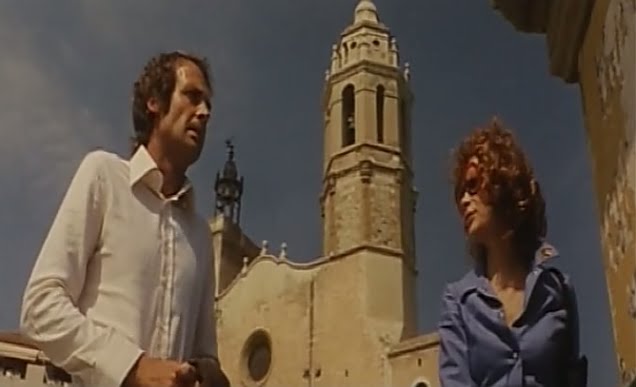
The title’s not as tenuous as you may think. The “red cats” bit references a witnesses description of the murderer, identity hidden under a red macintosh, plunging through rain-strewn shrubbery away from the scene of the crime. The “maze of glass” bit … ah, that would take us into spoiler territory.

Set in Spain, ‘Gatti rossi in un labirinto di vetro’ follows a package tour as they do the rounds of the tourist spots. Under the less than trustworthy aegis of tour guide Martinez (Raf Baldassarre) – a man who letches after anything in a skirt and enjoys playing not particularly endearing practical jokes – the group includes elderly cleric Reverend Bronson (George Rigaud), married couple Robbie and Gail Alvarado (Daniele Vargas and Silvia Solar), same sex couple Lisa (Mirta Millar) and Naiba (Ines Pellegrini), the laconic Hamilton (John Bartha) and his jailbait granddaughter Jenny (Veronica Miriel), and Paulette (Martine Brochard), ostensibly travelling alone but who bumps into her boss (and lover) Mark Burton (John Richardson). Mark is looking for a bit of the old in-out-in-out with Paulette while his wife Alma (Marta May) is recuperating at a clinic back in the States.

Then a murder occurs: a young woman, knifed to death and her left eye gouged out. A second killing takes place: one of the group, same modus operandi, during a ghost train ride at a funfair. Inspector Tudela (Andres Mejuto) – a week away from retirement – reluctantly gets saddled with the case. Tensions develop between the holidaymakers; suspicions are rife. Things get murkier when Mark discovers that Alma never showed up at the clinic and may be stalking him in Barcelona. Then there’s the revelation that certain parties might be implicated in a crime back in America; a guilty secret that has come back into their lives a continent away.

On one hand, ‘Gatti rossi in un labirinto di vetro’ is fairly boilerplate: the cop on the verge of retirement, the randy tour guide, the bickering couples, the unstable wife hovering in the wings. There are references aplenty to other films, most notably ‘Don’t Look Now’. The carousel of suspicion which whirls from one character to another until everybody on the tour bus seems to have motive, opportunity or hidden agenda is pure Agatha Christie. Red herrings swim through scene after scene with fishy abandon. The killer’s motive, when finally revealed, is as random as, say, that of the antagonists in ‘Strip Nude for Your Killer’ or ‘The Case of the Bloody Iris’.

And yet there’s much to enjoy: the peregrinations of the tour bus allows Lenzi to juxtapose the brief but full-blooded murder scenes against chocolate box cinematography; the focus shifts almost constantly, denying the easy identification of a protagonist and keeping an atmosphere of uncertainty simmering away; and the set-pieces are well staged, Lenzi cleverly orchestrating the comings and goings of the tourist group so that any one of them could have done the deed and no-one has a cast-iron alibi.

The cast do an okay job, even if the English dub I watched lumbers them with clunkily expositional dialogue. Elsewhere, though, ‘Gatti rossi in un labirinto di vetro’ delivers what you want from a giallo. The required amount of blood, nudity and J&B is present and correct. The whole thing moves along at a decent enough pace and Lenzi pulls some iconic and – at the denouement – effectively icky imagery out of the bag.

Friday, March 25, 2011

Elizabeth Taylor: magic and memories (guest article by Viv Apple)

Thanks to my good friend Viv Apple for this evocative and poignant piece.


The news on Wednesday of the death of Elizabeth Taylor, and the subsequent tributes and articles about that fabulous star, triggered memories I thought I’d long forgotten. In particular, ‘National Velvet’ (1944). It was this film which introduced me to the magic of cinema and made Taylor’s name as a child star, though she had also shone in ‘Lassie Come Home’ in 1943 - which I missed as I was evacuated to Staffordshire from London to avoid Hitler’s buzz-bombs.

I was a small girl with dark hair so I suppose I must have identified with Elizabeth Taylor – though I never consciously compared myself to the violet-eyed beauty. ‘National Velvet’ may not have been my first visit to the cinema, but it was the first film I can remember being moved by. The emotions engendered by child actors and animals in the story, and especially Elizabeth and Velvet, were as strong as falling in love and lasted longer than many love affairs.

From then on, my mother and I would walk the mile or so to the Astoria in Streatham High Road about once a week, and many of the films I saw then remain in my mind. When I was still very young another animal weepy, ‘The Yearling’, impressed me so much that I asked for the book (by Marjorie Kinnan Rawlings) for my birthday and read it with tears streaming down my face. Cartoons were a favourite of course, with ‘Bambi’ top of the list (more tears!). There must have been many funny cartoons (and indeed there were lighter moments in ‘Bambi’) but the most memorable cartoon for me was the terrifying ‘Fantasia’ with its overwhelmingly oppressive shapes of vivid colour advancing towards me as I cowered in the one-and-nines.

Cinema in the 1940s and 1950s was very different from what it is today, and not just because of the over-acting and immovable hairstyles. Smartly uniformed usherettes would show us to our seats with torches, and we would sit in the stalls waiting for the B movie to begin the programme - or it may have been Movietone News which came on first. Then I would beg for an ice cream from the lady with a tray of goodies and a long queue. At some point, a large organ would slowly emerge from its underground lair just in front of the screen and the organist would start playing the same tunes, week after week. Finally, after what seemed like an hour but was probably no more than ten minutes, the organ disappeared again and the screen curtains would open with a magic click, click, click... The beam of light from the projection room behind us was always alive with patterns of smoke from the patrons’ cigarettes, thick and dusty, as it shone messages from Pearl & Dean onto the screen.

But it wasn’t all wide-eyed fascination. If the organist was boring, that was nothing to some of the B movies. English films then had a reputation for being of a lesser standard than the amazing Hollywood productions, and many were cheaply put together to fill a gap. They must have been boring because I can’t remember any of them. There were honourable exceptions, such as the Ealing comedies, but these were the main feature and not the one to be sat through whilst fidgeting with the seat in front. Even some American films could be tedious to young eyes; adults loved the musicals of Busby Berkeley, with all the Busby Babes dancing on endless staircases in dreamy dresses, but we children found these sequences excruciatingly dull.

Now, of course, I can appreciate the skill and artistry of the old musicals. But the really great movies of the 1940s and 1950s have always been loved, both then and now. Great stars made them, and none greater than Elizabeth Taylor, whose remarkable career and life was more interesting than any movie.

Thursday, March 24, 2011

Shane Briant Tribute Site

Anyone who has followed Cinebeat’s articles on cult British actor, novelist and artist Shane Briant will already be aware of Robert Kenchington’s Shane Briant Tribute Site.

I knew Robert many moons ago in my pre-blogging days when a shared love of classical music and an appreciation of convivial drinking establishments defined some memorable evenings in Nottingham, Birmingham and London. After Robert’s move from the Midlands, I was remiss in keeping in touch and we fell out of contact for a while.

Then Robert’s email – with the appropriate subject line “a blast from your past” – landed in my inbox a couple of days ago; he’d recognized me from Agitation (despite the addition of a few years, more than a few pounds and a different haircut on the profile picture) and dropped me a line about his Shane Briant site.

For anyone who’s not visited and has the remotest interest in cult movies, go here. If there’s a more comprehensive Shane Briant resource on the web, I must have missed it!

Wednesday, March 23, 2011

Elizabeth Taylor


i.m. Elizabeth Taylor, 27 February 1932 – 23 March 2011

Tuesday, March 22, 2011

FINAL GIRL FILM CLUB: Blood and Roses

(Two posters and a haiku: positively my laziest ever contribution to the Final Girl Film Club. A tip of the chapeau to Bryce at Things That Don’t Suck; the first paragraph of his review gave me the idea.)


Oh, Annette Vadim!
Oh, Elsa Martinelli!
Oh, Sapphic vampires!


Monday, March 21, 2011

Dead Man (guest review by Bryce Wilson)

Thanks my good friend Bryce from Things That Don’t Suck for the following article.

‘Dead Man’ is an astoundingly pretentious movie. But don’t hold it against it.

Every now and again you come across a film that has seems not just odd but to have genuinely evolved along a separate evolutionary track. And that’s ‘Dead Man’ all the way, just your average Saturday Matinee on Alpha Centuri, where everyone watches B Movie Proto Mumblecore westerns that mix arch black and white style with, meandering quasi formed ideas about Native American Spirtuality and William Blake.

Even comparing it to Jaramusch’s other work offers little help. While his other movies inseredt sly signposts letting you know what level Jaramusch was putting you on, ‘Dead Man’ offers no such cheat sheet. Even comparing it to ‘Ghost Dog’, which has a similar schism between its offering of austere meditations on Bushido and its weird riffs on Seijun Suzuki and Tarantino, offers little help. It’s as if Jaramusch has gotten deeply invested in his mumbo jumbo, but is kind of embarrassed about it. It’s like having a conversation with someone who puts mocking air quotes around everything he says, and then concludes by going “Seriously though it was pretty deep.”

‘Dead Man’ follows Johnny Depp as a milquetoast accountant from Cleveland, who ends up on the run after killing the son of Robert Mitchum. Hunted by a gang of killers, and guided by the Native American Nobody who takes him for the (short lived) reincarnation of William Blake. However this makes the movie sound like it has a lot more form then it actually does. Most of the film consists of Depp simply wandering into weird shit.

‘Dead Man’ is at its best when it’s at its least self conscience, which isn’t often. There are the scenes with Robert Mitchum in full force of nature/wrath of God mode. Perpetually framed by a cheeky Jarmusch in front of stuffed Bears, Displays of guns, Giant Portraits of himself and other things that reflect what a bad motherfucker Robert Mitchum is. As well as the scenes following the trio of bounty hunters Mitchum hires to assassinate Blake, including a shockingly funny Michael Wincot, and Lance Henrikson as a man with more dark secretes then seem possible. Their sections resemble nothing so much as the laconic naturalistic bickering between the principles in the early Jarmusch masterpieces, like ‘Stranger Than Paradise’ and ‘Down By Law’. If one makes allowances for the fact that they occasionally kill people and eat one another. The particular punch line to their scenes is exceedingly dark.

This is one of those frustrating reviews. I know it doesn’t sound like it but I have some very real affection for this weird little mutant of a movie. Much like the Neil Young score that haunts it, the quality of ‘Dead Man’ all depends on your point of view. It’s either a sparse and haunting meditation, or as Ebert suggested the sound of a man dropping his guitar for two hours.

Then again who is to say that it can’t be both?

Sunday, March 20, 2011

GIALLO SUNDAY: Phantom of Death

Given that the last Ruggero Deodato title I approached was ‘Cannibal Holocaust’, I settled down very nervously to watch ‘Phantom of Death’. Please, no wholesale animal slaughter, I prayed as the opening credits commenced.

Fortunately, there were no snake, turtle or monkey eviscerations, although I did have to sit through Michael York doing the worst impersonation of a concern pianist ever committed to film. York plays Robert Dominici, an ivory tinkler of the classical persuasion. He’s involved with but unable to commit to the gorgeous Susanna (Mapi Galan) and lusted after by wealthy fashion designer Helene (the uber-gorgeous Edwige Fenech). Poor bastard – must be terrible for him.

As if decreed by the bit of cheap sarcasm in that last paragraph, things do get pretty awful for him very quickly. Susanna is murdered, the second victim of a brutal killer who has very recently despatched specialist consultant Dr Carla Pesenti (Carola Stagnaro). This inaugural killing is intercut with Dominici’s recital and sets up an interesting aesthetic: a very formal, slightly detached directing style punctuated by Argento-like set-pieces defined by prowling, subjective camerawork and grand guignol violence.

My very poor understanding of Italian translates the indigenous title, ‘Un delitto poco comune’, as something like ‘A Small Community of Crime’, which is an unwieldy title but one that contributes to the misdirection Deodato puts in place for the first half hour. With Dominici as a successful and acclaimed musician, the luckless Dr Pesenti an expert in her field, and the soon-to-be-in-danger Helene the head of that sooooo giallo of institutions, the fashion house, ‘Un delitto poco comune’ is the first indication that here we have a group of affluent types whose lives are under threat, either from a someone with a grudge, or an individual within their midst.

Added to this, Deodato throws in any number of expected genre tropes, from the bumbling copper, Inspector Datti (Donald Pleasance) seemingly unable to prevent each successive murder, to enough in the way of spiral staircases, rickety elevators, heads plunged through decorative glass, sharp instruments flashing in the dark, geysers of blood and non-linear editing to suggest ‘Phantom of Death’ was made in the glory days of the giallo and not a decade and a half later in 1988.

In fact, Deodato’s manipulation of his audience’s knowledge and expectations of two decades of gialli is the film’s biggest asset. For the first thirty minutes, you sit back comfortably convinced that Dominici is being established as the Sam Dalmas or Marc Daly du jour, the reluctant hero in the wrong place and the wrong time who’ll be required to turn amateur sleuth when Inspector Datti’s incompetence puts him in danger.

Not so. Deodato whips the rug out in commendably effective style with an hour still to go, shifting the focus to Datti and ramping up the tension as a cat-and-mouse game between cop and killer plays out, with Datti’s good-natured daughter Gloria (Antonella Ponziani) a potential victim and Helene’s role complicated as events take another unexpected turn.

Unfortunately, the English language title provides a heavy-handed clue from the outset (take the first two words, factor in the importance of musicianship, think of a very similar title in literature and film, and bear in mind the disfigurement of that anti-hero), the performances are all over the place (York chews the scenery like it had just got five stars in the Michelin Guide, Pleasance drifts through each scene on autopilot, and Fenech valiantly strives for more than the script gives her), and the dialogue is often embarrassingly bad. Particularly when Inspector Datti speculates “Why would anyone kill a doctor? Hmmm? Ah? Unless [pregnant pause] they had something to hide.”

Also, the film is riddled with inconsistencies. A file is stolen from Dr Pesenti’s office and yet a crucial appointment is noted in her diary, but Datti never thinks to cross-reference them. Dominici keeps fit by training with an oriental fencing expert – what the fuck??? A concert pianist engaging in a physical activity that could damage his hands?!?!?

But there are also plenty of genuinely creepy moments (the most effective involving nothing more than a peripheral character on a swing), as well as an unexpectedly melancholy subtext about mortality, the existence of God and, if He does exist, the cruelty of His grand design. ‘Phantom of Death’ is half-and-half an extrapolation of Argento-style aesthetics and an inquiry into what a giallo directed by Ingmar Bergman would be like.